
Cultural Wellbeing Architect & Educator
Building culturally Sensitive, anti-racist learning ecosystems in Classrooms & Beyond
Kind Child pedagogy · tailored interactions · restorative collaboration · Racial Healing Education
My work supports educators and teams to strengthen emotional security and high-quality relationships, with a particular focus on racism awareness and de-colonial practices in their daily work.
In Flanders, you can also think of my role as a pedagogical coach (pedagogisch coach) for childcare and care professionals.
Prefer Dutch? Lees dit in het Nederlands
What i Do
Little moments. Big impact.
In childcare and education facilities, ‘little moments’ are crucial: words, looks, routines, jokes, corrections—and also what is not said.
I help teams to become more aware of these moments and to translate them into tailored, respectful and restorative practice.
My programmes are not checklist-based diversity training. We build skills and agreements that your team will continue to use.

Who’s It For?
No need to already know how to do it—just be willing to learn.
👶Childcare workers, managers, educational coaches, coordinators
🩺Teams who work with diverse families and notice that “good intentions” are not enough
🤝Organisations that want to invest in sustainable quality development (not a one-off)
🌍 African diaspora concerned about building soft skills and education that are transferable back home
Let’s talk about your context
If you recognise some patterns of ignorance or emotional harm in your school, university or community, we can begin with a conversation.
No big performance, no instant solutions – just time to name what is present, ask questions and sense whether we are a good fit to work together.
You might be:
🧭 a school leader or care coordinator who feels the limits of “business as usual”
📚 a lecturer or researcher wanting to bring de-colonial practice into your teaching or projects
🤝 a community organiser, youth worker or parent looking for steadier ways to hold uncomfortable conversations
💬 a non-native student looking for sanctuary or a listening circle - a soft place to land or air frustrations and gain strength
If you’d like to explore what support could look like in your context, you can:

How I work
I keep things practical: real cases, clear language, and changes that feel doable. I also hold a strong protective container—no tokenising, no pressure to disclose personal stories, and no turning difficult topics into debate. And when possible, I bring in lightness and creativity, because they help people stay engaged and make the learning last.
-
My approach is healing-centred, anti-racist, and decolonial, with an emphasis on impact and repair rather than guilt or perfection:
Healing-centred: we work with the emotional and bodily impact of harm, not only ideas
Anti-racist & decolonial: focused on impact, patterns, and repair (not guilt or perfection)
Practice-based: real cases, simple language, doable changes
Protective: no tokenising, no forced disclosure, no “debate club” dynamics
Light when possible: because play, warmth, and creativity help learning land
-
My background brings together lived experience, professional practice, and ongoing self-directed learning across care, education, and intercultural facilitation:
Multicultural & transnational grounding
Multicultural roots and long-term experience living and working across Flemish and UK contexts, with ease navigating intercultural, institutional, and community-based environments.Care- and education-sector experience
Professional experience across care and education settings, with a strong focus on emotional safety, accessibility, and learning environments that protect dignity and wellbeing.Anti-racist & decolonial practice
Contributor to Sankaa vzw’s Racism Unravelled (Racisme Ontrafeld) research, translating anti-racist analysis into practical learning for care and education professionals.Dialogue & facilitation experience
Participant in Avansa Oost-Brabant’s De Conversaties (Leuven/Louvain), a facilitated dialogue experiment on Belgium’s colonial past and its present-day impact—designed explicitly as dialogue rather than debate.Self-directed, interdisciplinary learning
Largely autodidact, shaped by continuous self-directed study across social justice, facilitation, spirituality, and embodied approaches to learning—comfortable integrating theory with lived experience.Group dynamics & leadership
Extensive experience holding responsibility within group settings, with a strong ability to read dynamics, support participation across difference, and maintain clear, protective boundaries.Healing-centred & embodied approaches
Grounded in practices that recognise the emotional and bodily impact of harm, informed by care work, disability awareness, and spiritually grounded approaches to regulation and connection.Nature-informed perspective
A long-standing relationship with nature as a grounding presence, informing a respectful, relational, and globally informed perspective that draws on elemental and indigenous ways of understanding connection and belonging.
-
You can expect a warm container, clear agreements, and tools that show up in real life: meetings, parent conversations, staff onboarding, and daily care routines.
-
I’m currently focused on supporting Flemish childcare and care teams, while building work that can adapt internationally. The method stays consistent; the historical and cultural context adapts.
Current work & collaborations
This work is already happening in many small, steady ways across Belgium. A few of the collaborations that shape my practice:
⚓ Sankaa Vzw – Racism Unravelled & Safe Harbour
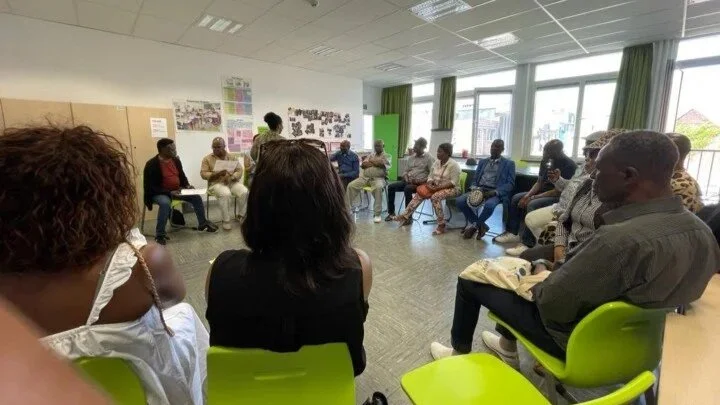
Facilitating spaces where people of African descent and allies can name and unpack experiences of racism, stigma and institutional harm, and explore what healing and repair might look like in daily life.
🤝 Diversity & Belonging in higher education
Co-designing and facilitating trainings for third- and fourth-year BA students in the care sector (hogescholen / universities), translating research on racism and colonial legacies into embodied, practical tools for future professionals.
🧸 Belonging in Early Years (kinderopvang)
Researching how belonging, emotional wellbeing and leadership opportunities are (or are not) nurtured for young children of African descent in day-care settings across Flanders, with a focus on the everyday practices of care.
🗣️ Community dialogues on colonial history
Contributing to initiatives such as Avansa Oost-Brabant’s “De Conversaties” in Leuven – moderated, multi-voiced spaces where people explore Belgium’s colonial past and its living traces using trauma-informed methods and deep listening.
🎭 Youth programmes & creative camps
Designing and coordinating two-week-long summer camps and shorter programmes where young people work with theatre and the four elements — air, water, fire, earth — to build emotional intelligence, social awareness and life skills in a light, supportive setting.
“These collaborations keep the work grounded: in bodies, in local realities, in communities who are already thinking and feeling deeply about these questions.”

“From lived experience to lived practice: I turn complex histories and real-world harm into learning that lands—through warmth, protection, and repair.”