Reflection Before Resolution
Ground Notes, Part Five
What Becomes Visible When We Pause
In busy families, classrooms and childcare settings, pausing can feel like a luxury. There are meals to prepare, transitions to manage, several children needing attention and often very little emotional or practical space around the adult.
Urgency encourages us to decide quickly what a behaviour means and what must be done about it. Yet a pause does not have to be long. It might be one breath, a hand resting against a table, or a moment of noticing the tension gathering in our shoulders before we speak.
Prioritising that small space can bring us back into contact with what is alive in the moment: the child’s distress, our own activation, a boundary that needs protecting or a need that has not yet found language.
The pause is not the absence of action. It is an opportunity to let our next action come from connection rather than momentum.
Entering the Practice
You might begin by bringing to mind a recent interaction that unsettled you. It does not need to be the most difficult encounter you have experienced. A small moment—one that left some tension, uncertainty or unfinished feeling behind—may offer enough ground for reflection.
There is no need to move through the following questions quickly or answer all of them. Notice which question creates an opening and which one you feel tempted to avoid.
What happened?
What could a camera have recorded?
This question helps separate observation from interpretation.
“The child pulled the bicycle from another child’s hands” is an observation.
“The child was being deliberately mean” is an interpretation.
Interpretation is not inherently wrong. We need it to make sense of our experiences. But when an interpretation arrives too quickly, it can begin directing our response before we have noticed what else might be present.
What changes when you remain with what was observable for a little longer?
What happened inside me?
What feeling, bodily sensation or impulse appeared?
Perhaps your shoulders tightened.
Perhaps you wanted the noise to stop immediately.
Perhaps you felt protective of one child, irritated with another or anxious that people would think you were not managing the situation properly.
Our internal response is also part of what happened. Recognising it does not make the child responsible for regulating us, nor does it require us to suppress what we feel. It simply allows us to notice what we may otherwise carry directly into our next action.
What was I trying to protect?
Was it safety, fairness, order, belonging, quiet, authority or connection?
Several of these may have been present at once. Sometimes the value we are protecting is important, while the way we try to protect it creates distance or shame.
What might it look like to uphold the boundary without losing contact with the person before us?
What comes after “because”?
I needed them to stop because…
I became angry because…
I intervened quickly because…
What need, fear, memory or expectation appears when you allow the sentence to continue?
The first answer may not be the only one. Staying with the question can reveal layers that were not available in the urgency of the moment.
Whose need is this?
Is this a need for the child to meet, for me to regulate or for us to hold together?
This can be one of the more difficult distinctions to make. Adult and child needs often meet in the same moment, but they do not carry the same responsibilities.
The question is not asking us to erase ourselves in favour of the child. It asks us to consider what belongs to whom—and where support, repair or shared regulation may be needed.
Making Room
Reflection is not intended to produce an immediate solution to every disagreement. Sometimes the first task is simply to see more clearly: what happened, what was stirred in us and what the moment may have been asking for.
A solution reached too quickly can restore order without restoring connection.
Nor does reflective practice require every family disagreement or difficult classroom moment to become a formal conversation. It is not a script for becoming a permanently calm, perfectly self-aware adult.
It is an invitation to make room.
Room between an event and our interpretation of it.
Room between feeling something and acting from it.
Room for the child’s experience without erasing the adult’s.
Room for boundaries that protect without humiliating.
Room for curiosity after certainty has already begun sharpening its elbows.
A Form Beginning to Emerge
As I have worked with these questions through Ground Notes, they have gradually begun asking for a form of their own.
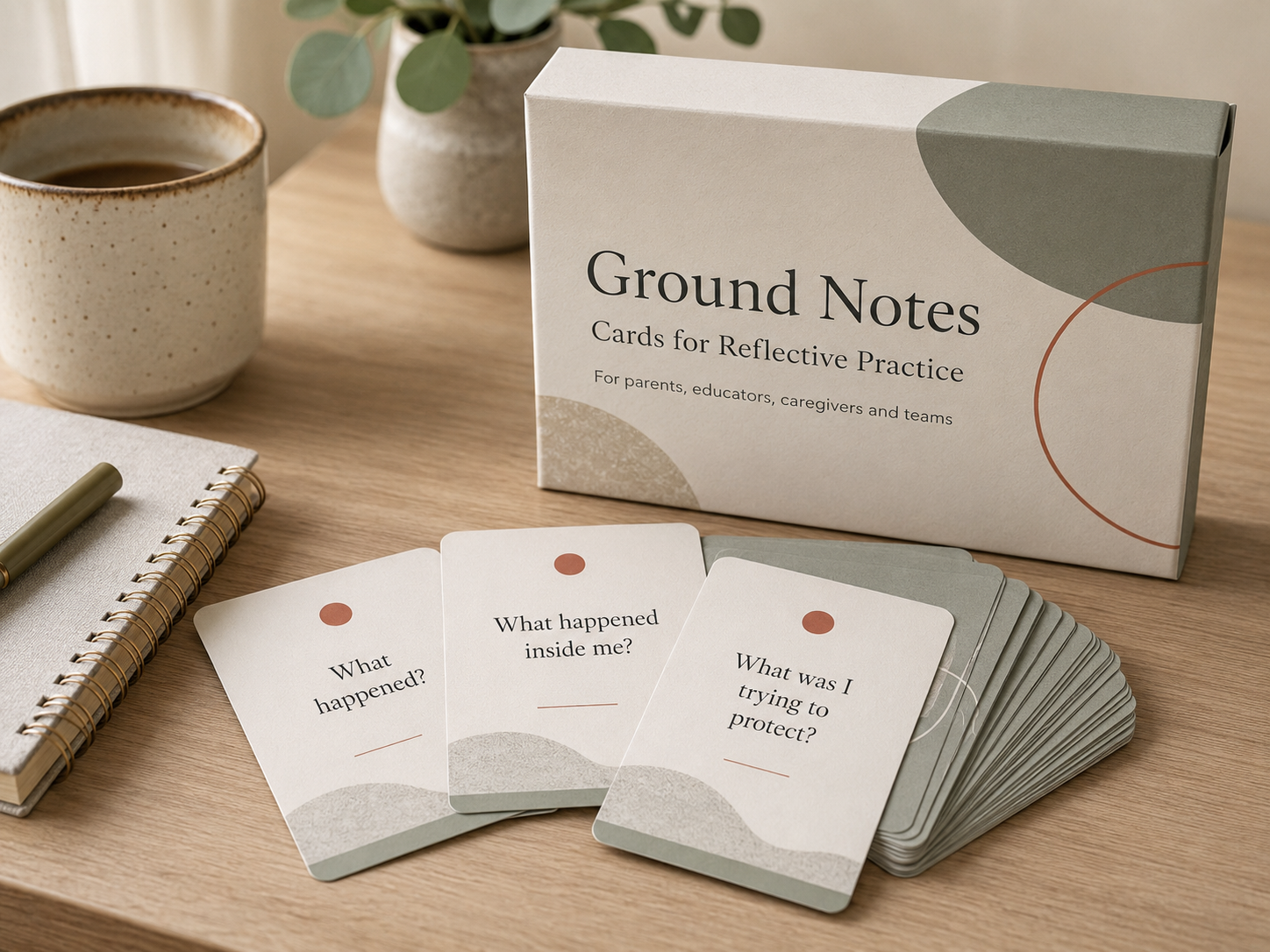
I am exploring the development of a set of Ground Notes Reflective Practice Cards that could hold these and other prompts. They might be used individually, between partners, in family conversations, during team reflection or within facilitated workshops.
The image accompanying this post offers an early visual possibility rather than a finished product. The language, structure and practical form are still growing, and I want to allow that development to follow the pace of the inquiry from which it emerged.
For now, the questions are already here. They grow from lived experience, cultural curiosity, reflective practice and the belief that what happens between us deserves more than our fastest explanation.